
You are looking at a stained driveway wondering what to buy. Start cheaper: sweep it, hose it, then detergent and a stiff brush, and reach for a chemical only once those have failed. That order is CBA’s, the Clay Brick Association, whose test is whether “dry sweeping or washing with clean water and a detergent fails to bring the pavement to an acceptable state of cleanness”. We restore paving for a living and sell neither a machine nor a bottle, so we can say where the ladder stops.
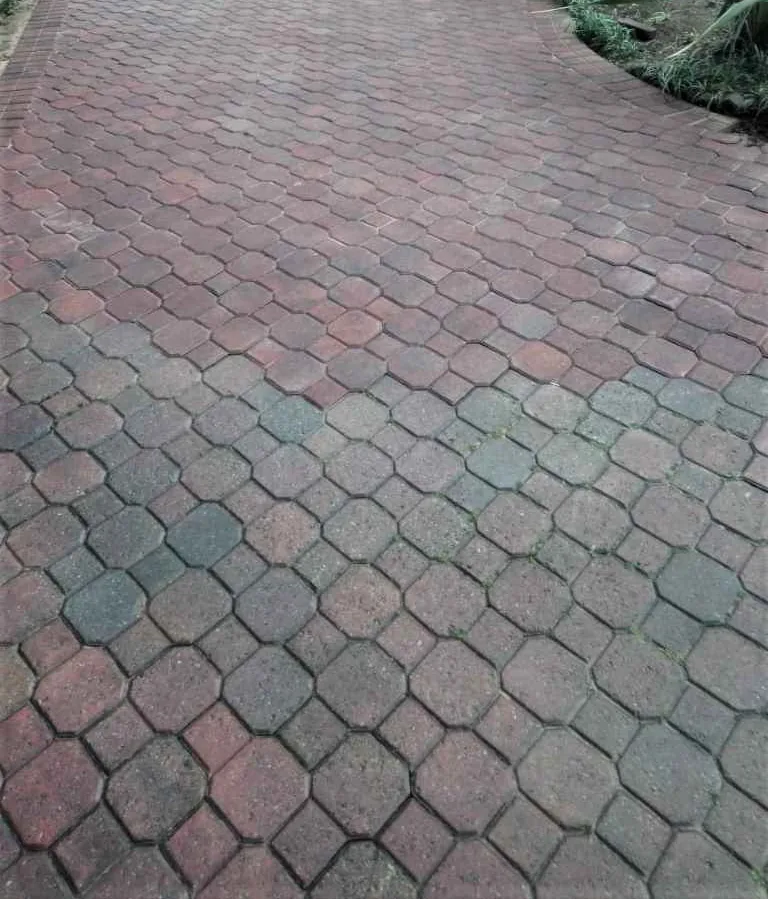
Start With the Least Aggressive Method That Works
A broom and a hose do most of the work: “Frequent sweeping and hosing will usually ensure a clean pavement”, in CBA’s words, and Bosun and SmartStone open with the same two tools. Whatever you use next, try it on a small inconspicuous patch first, which CBA, SmartStone, Bosun and ICPI all specify. Work a stain from the bottom up the slope, a direction ICPI adds.
- Dry sweep with a hard-bristled broom, then hose with clean water.
- Detergent and a stiff brush. For heavily soiled paving Bosun uses a general-purpose cleaner, pH neutral to slightly alkaline and non-abrasive, rinsed off afterwards.
- A cleaner made for pavers, which ICPI, the US concrete paving trade body, says “should be used whenever possible”.
New paving gets a broom and nothing else at first. The joints are still filling themselves: road detritus works down and locks the units together, “usually well established after about three months of pavement usage”, says CMA, the concrete trade body. Over the same window CBA rules out hoses and powered vacuum cleaners, “not recommended during the first three months of the pavement use”.
What a Pressure Washer Does Well, and What It Costs You
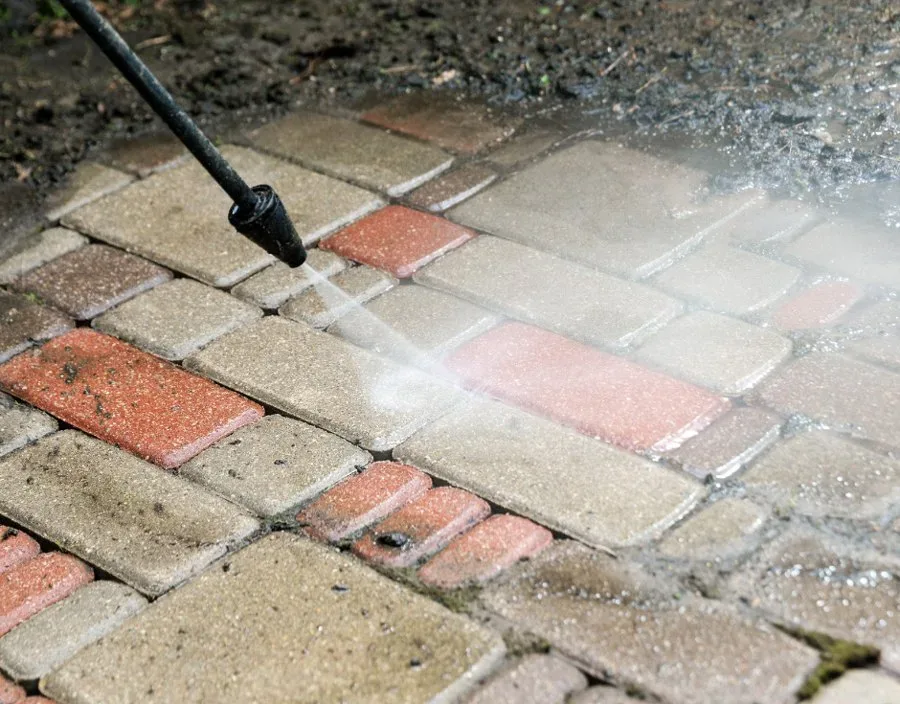
A pressure washer cleans paving fast, and can wash the sand out of your joints while it does it. Power hoses “may wash out jointing sand (grouting)”, so Bosun says do not use one, and CBA warns some pavers can be damaged by overuse. Against that, SmartStone permits one on “the widest setting of the spray nozzle”, angled rather than fired into joints, and ICPI treats it as the professional method.
Technique matters more than pressure: wide nozzle, low angle of attack, because “a large amount of water is more important to rinsing than high pressure”, says ICPI.
Cleaning Specific Stains
What the mark is decides the treatment, and two of them have no home remedy.
| Stain | Published guidance | Source |
|---|---|---|
| Oil and grease | Blot, never wipe: wiping “tends to force the oil into the pavement”. Dry absorbent, a day, sweep up, then a strong detergent. “Most oil stains are permanent”, though they do no structural harm. | CBA; ICPI; Bosun; CMA |
| Tyre marks | Usually removed by scrubbing with hot water and a strong detergent, then rinsing. Scouring powder added by ICPI. | Bosun; ICPI |
| Moss, algae, lichen | Brush when dry, then a fungicide left “three to four days” to act. “Some of the poisons in fungicides may discolour the pavement”, and watch nearby plants on the lower side. | CBA |
| Efflorescence | Superficial, no effect on durability or strength, and usually disappears of its own accord. In Gauteng it shows most in the rainy summer months. | CMA; SmartStone |
| Rust | Referred to a cleaning professional rather than a home remedy. | Bosun |
Acid: What the South African Trade Actually Says
Our own restoration work starts with a deep clean and a chemical wash, so we are not neutral. The trade does not agree on acid, and the split is worth seeing before you pour anything.
| Source | Position on acid |
|---|---|
| CBA (clay trade body) | Hydrochloric for hardened mortar, “starting with one part of acid to ten parts of water” and then reducing the water until it works |
| Tuscan Stone (SA maker) | 1:10 for efflorescence, without naming the acid |
| CMA (concrete trade body) | Permits an acid wash for efflorescence |
| SmartStone (SA maker) | “While not recommended”, permits a diluted acid-based product |
| Bosun (SA maker) | Advises against acid and other DIY solutions for rust, concrete, plaster and paint marks |
| ICPI (US trade body) | Redirects to buffered products that clean “without damage to the paver surface”, and says these “should be used whenever possible” |
Six sources sounds like a consensus, and it is not one. All say try a patch first. They differ on where they send you: buffered products made for pavers are named only by ICPI, while CBA and Tuscan publish their own dilutions instead. We follow ICPI: identify the stain, use a product made for pavers, test a patch, control the runoff, rinse fast.
If You Are Going to Use Acid
Hose the paving down first. Dry bricks drink whatever you put on them: wetting first “will prevent them from absorbing it, as they will soak up the clean water first”, is SmartStone’s reason, and SmartStone ties a slow rinse to damage. That is a rule for acid washing, not every chemical: CBA specifies no pre-wetting for two of its vanadium treatments on clay. One safety line sits above all of it, CBA’s: always add acid to water, never water to acid.
Will Cleaning Take the Colour Out?
Less easily than you would think. The colour is not a coat on top: it is bound into the unit, at least 5 mm below the surface you walk on, set by SANS 1200 MJ at clause 3.1.1, which is why a paving brick survives cleaning that strips a surface-pigmented product. Deep is not infinite, though. Strong acid cleaners “will change the color of the pavers slightly”, ICPI warns, and a second application may “expose some aggregates”. How much any method takes off is not published anywhere we hold.
Joint Sand, and the Weeds That Live In It
Cleaning Is Not Finished Until the Joints Are Refilled
Joint sand is structural: a clean that empties the joints costs more than it gains. It is “critical to maintain the jointing sand between units in order to avoid movement that may result in paver shunting and/or chipping”, says CBA. Inspect and refill once the paving is clean, which Bosun instructs and SmartStone builds into its inspection routine. One warning from SmartStone: “Do not use cement grouting to try and fix the problem.”
How to Remove Weeds From Paving
Weeds in paving almost never come up from underneath. “Ninety per cent of vegetation growth in large paved areas” is wind-blown seed germinating in the jointing sand, according to CMA, with a test you can run: pull one up and see where the stem ends and the roots begin. The same reading comes from Bosun and SmartStone, which credit regular hosing and sweeping with disturbing new weeds.
- Plastic sheeting under paving does not work. Its use as a vegetation inhibitor “is not recommended”, says CMA, and Bosun adds that it harms structural integrity and drainage without stopping weeds, which arrive from above.
- Weed killers carry a cost. They “are often known to stain or damage paving”, says Bosun, and CMA refers readers to expert advice rather than a product.
Efflorescence that keeps returning can point at insufficient drainage below the pavers, which SmartStone flags. Paving that has shifted or sunk needs lifting, not scrubbing: an Olympus patio in Pretoria East was that job: pavers lifted, cleaned, base re-levelled, relaid. Where the colour has gone from a sound surface, that is restoration work; finished jobs sit in the gallery.
Frequently Asked Questions
How often should I clean paving bricks?
Can I use a pressure washer to clean paving bricks?
Is acid safe on paving bricks?
How do I clean paving without harming my garden?
Most paving here is dirtier than it is damaged, and a broom and a hose settle more of it than any product. When they do not, request a quotation and we will look at it on site free. Pretoria Paving has worked across Pretoria and Centurion since 2017 and holds 4.9★ on Google.