
Walk into a paving yard and you are shown bevel, cobble, interlocker and flagstone. Those are shapes and trade names, not materials. Underneath them sit three families that behave differently: pressed concrete, wet-cast concrete and fired clay. Two standards cover them, testing different properties, which is why datasheet numbers rarely compare.
The Three Families Behind the Trade Names
Pressed (Dry-Cast) Concrete
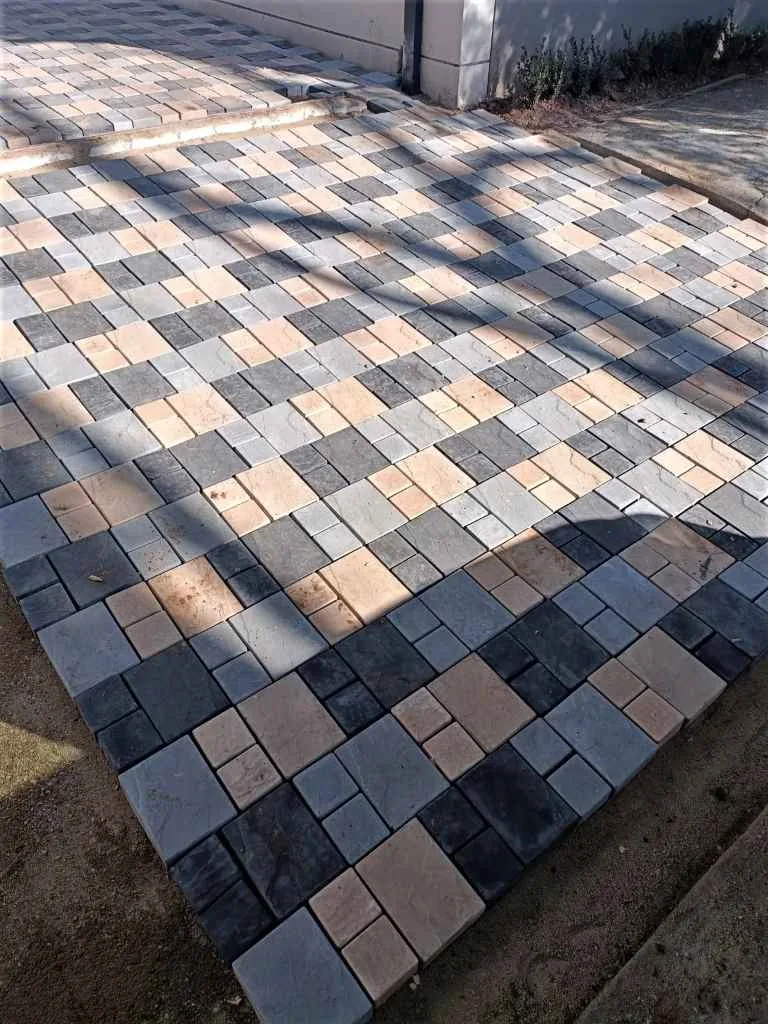
The default on Pretoria driveways, sold as both concrete paving bricks and cement paving bricks. The proper term is concrete paving block, the title of SANS 1058. SANS 1058 tests tensile splitting strength, abrasion and water absorption, not compressive strength, and covers units 50 to 120 mm.
Wet-Cast Concrete
Bigger formats and textured faces, poured rather than pressed. That is how SmartStone and Tuscan Stone describe their ranges, and SmartStone cites the American ICPI rather than SANS.
Fired Clay
Clay paving answers to SANS 1575, classes PA and PB, with strength given as modulus of rupture. It sets a floor the concrete standard does not: 50 mm nominal thickness. The clay name here is Corobrik, at 50, 65 and 73 mm.
Natural Stone, and the Flagstone Trap
There is no South African standard for natural stone paving, and no supplier publishes a tolerance for it. The flagstone you are shown is almost certainly not stone: Infraset, Bosun, SmartStone and Tuscan Stone all list flagstone categories, and every one is concrete.
Clay Paving vs Concrete Paving Bricks
| What is specified | Clay paving units | Concrete paving blocks |
|---|---|---|
| Standard | SANS 1575 | SANS 1058 |
| Classes | PA and PB | 30/2.0 and 40/2.6 |
| Strength test | Modulus of rupture, PA 4.0 MPa nominal | Tensile splitting, 2.0 MPa average for 30/2.0 |
| Minimum thickness | 50 mm nominal, set by the standard | Not set. Left to the specifier |
| Colour source | Fired mineral and oxide content | Pigment, 5% and never above 10% by mass of cement |
| Published absorption | Corobrik: above 7% and 8%, stated as typical | SANS 1058: 6.5% average, 8% individual maximum |
MPa is where the clay versus concrete argument goes wrong. Ask which test produced any strength figure you are quoted: concrete is specified on tensile splitting, clay on modulus of rupture, and Corobrik adds a compressive strength above 50 MPa for Cederberg Modular. Three tests, three properties. Clay is not the drier option either: Corobrik’s published absorption sits at or above the concrete limit.
Colour: What Is Tested and What Is Sold
Neither standard tests colour permanence; what concrete specifies is depth: the colour “shall penetrate to a depth of at least 5 mm below the wearing surface”, bound into the body of the unit (SANS 1200 MJ clause 3.1.1). A compliant paver is not surface-pigmented. On clay, Corobrik states the colour does not fade, with no test method behind it, while Bosun, a concrete maker, lists “fading colour” as an issue for its own ranges. What reads as fading is usually lime bloom, which the Concrete Society says weathers off in rain, or wear on the face layer.
What the Standard Fixes, and What It Leaves to You
Thickness, and Why 60mm Is Not a Rule
There is no standard thickness to look up. Type, class and thickness are left to whoever specifies the job: blocks “shall be of the type scheduled or given on the drawings” (SANS 1200 MJ), and CMA’s commentary on the same clause is explicit that “the specifier must decide on the type, class and thickness of paving block.” For a house the figures are 50 to 60 mm, industrial work 80 mm (CMA Book 2), with Book 3 adding that unnecessarily thick blocks “will only increase cost without improving service performance”. The UTG 2 catalogue uses 60 mm for municipal roads.
The bricks in the yard agree. A 200 × 150 × 50 mm cottage and a 200 × 100 × 50 mm bevel sit on MVA Bricks’ SABS permit at the same class as the 60 mm and 80 mm interlockers, though that permit expired in 2024, so it records what was certified, not current status. The Cottage that Infraset markets for “walkways, driveways, traffic islands, parking areas, municipal paving” prints no thickness. Yet Tuscan Stone’s 60 mm unit, Matera, is a 300 × 50 mm plank. So “60 mm minimum for anything a car drives on” is a trade habit, not a standard. Where habit and standards disagree, follow the standards.
Class: The Dearer Specification Is Not the Better One
The higher block class has one trigger: a wheel load above 30 kN, or a project specification scheduling it (SANS 1200 MJ). Older documents call the two Class 25 and Class 35; current designations are 30/2.0 and 40/2.6, the second number being the required average tensile splitting strength.
A higher class costs more and buys nothing on a home driveway. Performance “is dependent on the degree of interlock, which spreads the load and is virtually independent of the strength of paving blocks”, and an unnecessarily high class “will only increase the cost of paving without improving its performance”. Both quotes are CMA Book 3.
Reading the Block Type Off the Brick
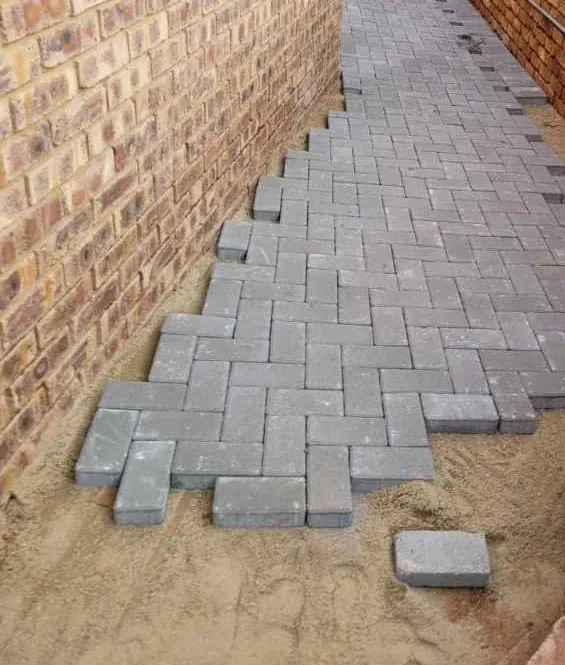
Pick up a sample and look at its outline. Blocks are sorted by plan shape into three types under SANS 1058: S-A keys into its neighbours on every face, S-B on some, S-C on none. S-A resists creep best, and S-B and S-C get chosen for looks (CMA Book 2). None of the eight suppliers declares a type, so you settle it by eye. A plain rectangular bevel relies on the laying, which is why pattern, jointing and edge restraint matter most on it.
Which Type of Paving Suits Which Application
| Driveway | Patio | Pool surround | Walkway | |
|---|---|---|---|---|
| Pattern | Herringbone, 45° or 90°, where the shape permits | Open; basketweave and stack bond are pedestrian | Open, as patio | Open, as patio |
| Thickness | CMA: 50 to 60 mm for domestic use | Same band | Nothing specific published | SmartStone lists a 40 mm cobble |
| Block type | S-A resists creep best; none declared | Aesthetic | Aesthetic | Aesthetic |
| Falls | 2% minimum crossfall | 2% | 2%, away from the pool edge | 2% |
| Infraset markets | Cottage for driveways, parking | Masonique for patios, malls | Masonique for pool surrounds | Cottage and Masonique |
Pattern is the one hard constraint there. Whatever brick you pick for a driveway in Pretoria or Centurion, the units must be “laid in a herringbone pattern if the block shape permits”, otherwise with the long axis across the traffic (SANS 1200 MJ). One row we cannot fill: nothing we hold recommends clay over concrete, or the reverse, for any application. Treat pool-surround slip ratings the same way, since South Africa has no slip standard for paving.
Buying: What to Ask Before You Order
None of the eight suppliers publishes prices, so you compare on specification. Get four things in writing: dimensions, units per square metre, mass per block, and the certificate covering that size. Certification runs on two routes, each with a public register: an SABS permit, and a certificate from CMA Certification Services, a SANAS-accredited body. Either covers named sizes and classes rather than a company, and the registers are separate, so a manufacturer absent from one may sit on the other.
For products rather than the decision, our paving brick range and concrete paver page cover what we lay most. We have worked across Pretoria and Centurion since 2017, in pressed concrete, wet-cast and clay. A two-tone Infraset driveway at Irene Farm Villages ran 115 m² of Masonique charcoal with Cottage Sahara sand. More sits in the gallery.
Frequently Asked Questions
What are the main types of paving brick sold in South Africa?
Is clay paving better than concrete paving bricks?
What thickness of paving brick do I need for a driveway?
Does clay paver colour last longer than concrete?
Are stronger or thicker pavers worth paying for?
Pick the material for the look and the budget, then spend the argument on layerworks, pattern and edge restraint. Driveway paving is quoted after a free site measurement and carries our 20 years written guarantee. Request a quotation and we will measure on site. Pretoria Paving holds 4.9★ on Google.